Saturday, June 27, 2009

200 sit up challenge: week 1

Day 1Day 3Day 5
15 sit-ups15 sit-ups17 sit-ups
60 seconds60 seconds60 seconds
18 sit-ups18 sit-ups22 sit-ups
60 seconds60 seconds60 seconds
10 sit-ups15 sit-ups14 sit-ups
60 seconds60 seconds60 seconds
10 sit-ups15 sit-ups14 sit-ups
60 seconds60 seconds60 seconds
>14 sit-ups>18 sit-ups>20 sit-ups

From here.

100 push up challenge: week 1

Day 1Day 3Day 5
10 push-ups10 push-ups11 push-ups
60 seconds90 seconds120 seconds
12 push-ups12 push-ups15 push-ups
60 seconds90 seconds120 seconds
7 push-ups8 push-ups9 push-ups
60 seconds90 seconds120 seconds
7 push-ups8 push-ups9 push-ups
60 seconds90 seconds120 seconds
>9 push-ups>12 push-ups>13 push-ups

From here.

Saturday swimming

70 lengths (1750 yards) in 45 minutes.

Thursday, June 25, 2009

Argument diagramming

Chris Reed, Douglas Walton and Fabrizio Macagno (2007). "Argument diagramming in logic, law and artificial intelligence". The Knowledge Engineering Review, 22(1), 87-109.

Some notable fields: informal logic, argumentation theory, evidence law, legal reasoning. Argument diagramming was first used in these fields, but is recently attracting interest in AI and CS.

Argument diagrams - nodes/vertices represent propositions, and arcs/edges represent inferences.

Argument Markup Language is an XML application for representing arguments/argument diagrams. Araucaria is a software tool for interactively creating an argument diagram by annotating a source text with propositions and inferences.

Enthymemes - arguments which have implicit premises or conclusions, which are not explicitly expressed in the discourse.

The 'milk' argument ("Drink milk - Lose weight?"):

Looking to drop a few pounds? Including enough milk in your reduced-calorie diet could provide the nutritional support you need for healthy, effective weight loss. In fact, emerging research suggests that drinking three glasses of milk daily when dieting may promote the loss of body fat while maintaining more muscle. The calcium and protein in milk may help explain these weight loss benefits. Recent studies indicate that calcium is part of the body's natural system for burning fat, while protein is essential for building and keeping muscle. And milk is the only beverage that naturally provides the unique combination of calcium in protein for healthy, effective weight loss support. In fact, no other single food item provides more calcium to America's diet than milk. So it's time to add healthy weight loss to the already extensive list of good things that milk can do for your body. If you're serious about losing weight the healthy way, make sure to exercise, limit your calories and drink at least three glasses a day of low fat or fat-free milk, which has the same amount of calcium, protein and other nutrients as whole milk. For more information on these key studies, and additional important research on dairy and weight loss, visit healthyweightwithmilk.com

Jobs in Dundee

Two RA jobs on the (EPSRC-funded) Dialectical Argumentation Machines project.

Thursday swimming

60 lengths (1500 yards) in 40 minutes.

Wednesday, June 24, 2009

Latitude and longitude

The latitude of a place expresses how far north of the Equator it is.

  • North Pole: 90º
  • Arctic Circle: 66.56756º
  • Tropic of Cancer: 23.?º
  • Equator: 0º
  • Tropic of Capricorn: -23.?º
  • Antarctic Circle: -66.56083º
  • south pole: -90º

The longitude of a place expressed how far east of Greenwich it is. The International Date Line can be expressed as either 180º or -180º.

Edinburgh is approximately 56º latitude, -3.2º longitude. In Google Maps, this is expressed using the following URL:

http://maps.google.com/?ll=56,-3.2&z=10

Google maps basics

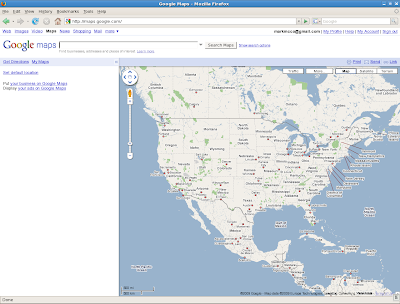
Start by going to the URL http://maps.google.com. Assuming you are signed in, you should see something like the following:

This page has three parts:

  1. the search pane, at the top
  2. the info pane, on the left
  3. the current map pane, on the right

The info pane can be minimised, in order to increase the size of the current map pane.

Things you can do with the current map pane:

  1. Click on one of the arrow icons at the top left to scroll north, south, east or west to a new map. If you click on the hand icon in the centre, you will be taken back to the original map.
  2. Click and hold the mouse button - the pointer change from a hand to a clenched fist, which you can drag around to scroll in any direction you want to a new map.
  3. Click on the plus or minus icons on the left in order to zoom in or out to a new map. You can also drag the bar between the two icons to zoom faster.
  4. Double click the mouse button to centre the map on a new point AND zoom in one level, thus giving a new map.
  5. Use the hyperlinks at the top right of the map pane to switch between map, satellite (with or without place names) and terrain view of the current map.

Other things you can do:

  1. Reset your default map, using the relevant link in the info pane.
  2. See the URL of the current map, using the 'link' link at the top right of the current map pane.
  3. Email that URL to someone, using the 'send' link.
  4. Right click, 'what's here?'

Google mapplet basics

From this page here.

A mapplet is an XML file on your own webserver, which overlays stuff on the standard Google maps page. You run the mapplet in your webbrowser as follows:

http://maps.google.com/ig/add?synd=mpl&pid=mpl&moduleurl=...

For example, here is mine.

Here is the code for my mapplet:

<?xml version="1.0" encoding="UTF-8"?>
<Module>
  <ModulePrefs title="Bum bum bum" 
               description="Says bum a lot"
               author="Mark McConville"
               author_email="markmcco@gmail.com"
               height="150">
    <!-- load the Google mapplets API -->
    <Require feature="sharedmap"/>    
  </ModulePrefs>
  <Content type="html"><![CDATA[
    <!-- Add a title to the left-hand info pane -->
    <h2>Bum bum bum!</h2>
    <!-- Manipulate the map pane -->
    <script>
      <!-- create a new map -->
      var map = new GMap2();
      <!-- centre the map in middle of Mediterranean and zoom out to level 2 -->
      var point = new GLatLng(37.71859,6.679688);
      map.setCenter(point,2);
      <!-- add a marker/pin to the point -->
      var marker = new GMarker(point);
      map.addOverlay(marker);
      <!-- add an info bubble to the marker -->
      marker.openInfoWindowHtml("Bum bum bum!");
    </script>
    ]]>
  </Content>
</Module>

Some facts about Heathrow Airport

From the first episode of the BBC4 TV series 'The Secret Life of the Airport':

  1. The original airport was built (in the late 1940s) with six runways (each about one mile in length) in a star of David form. This was because contemporary airplanes needed to take off into the wind, in order to gain lift. The two east-west runways were extended during the early 1970s, and the other runways were removed to allow for terminal expansions or turned into taxiways
  2. The three original terminal buildings were built during the 1950s and 1960s at the centre of the airport, i.e. within the internal hexagon. Tunnels were built under the runways to allow access. One of the flaws in this design was lack of space to build carparks - the original architects had assumed that air travel would always be reserved for the rich, who would be driven to the terminal buildings by their chauffeurs. Terminals 4 and 5 were built later outside the original star, on the south and west of the airport respectively.

Tuesday, June 23, 2009

Tuesday swimming

60 lengths (1500 yards) in 40 minutes.

Monday, June 22, 2009

How the Celts saved Britain - Salvation

Episode of 2 of Dan Snow's new history programme How the Celts Saved Britain, where he "blows the lid on the traditional, Anglo-centric view of history and reveals how the Irish saved Britain from cultural oblivion during the Dark Ages". My summary of episode 1 can be found here.

Mid-sixth century: The former Roman province of Britannia had reverted to an uncivilised (i.e. illiterate, pagan, iron-age, inward-looking) patchwork of warring Anglo-Saxon tribes, ruling over the native Britons. In contrast, Ireland was a civilised (i.e. literate, christian, technologically advanced, outward-looking) society, dotted with monasteries. The Irish/Gaelic kingdom of Dalriada was based at Dunadd in present-day Argyll, and the rest of Scotland was dominated by Picts.

563: Twelve Irish monks sailed from Ireland to Dunadd, led by Colum Cille (later known as Saint Columba, 521-597), a rising star of the Irish church (and descendant of the high kings of Ireland). Columba intended to spread the christian faith in Pictland, and to this end he asked the king of Dalriada to give him a piece of land to build a church. He was given the little island of Iona, on the western edge of Scotland.

Iona was to become the 'Westminster Abbey' of early medieval Scotland, a place where religious and political power came together. As a mark of this, Columba blessed the new king of Dalriada, Áedán mac Gabráin (d. 609) on Iona, in a christian ceremony. Iona also become the main cultural centre for Celtic christianity - It was on Iona that the Book of Kells (a lavishly illustrated copy of the four gospels) was created, one of the great achievements of western art.

In the late 560s, after the church on Iona was complete, Columba set out along the Great Glen, to start converting the Picts. He confronted King Bridei (d. 585) at his fortress near Inverness, impressing him with his christian 'magic' (for example, chasing off the Loch Ness monster!). Over the course of time, the Picts became christianised and subsumed into Gaelic culture and language, thus forming the race of the Scots (see the Aberlemno standing stones in Angus).

Down in England, an attempt was already being made to reintroduce christianity. In 597 Pope Gregory the Great (540-604) sent a mission, led by the Benedictine monk Augustine of Canterbury (d. 604), to the Kingdom of Kent to meet King Æthelberht (560-616), who had married a christian Frankish princess, Bertha. This was part of Gregory's imperial ambitions to reassert centralised Roman control over western European christians, and in particular to counteract the influence of the (self-governing) Irish monasteries. Æthelberht himself converted to christianity, and mission moved on to London (in the Kingdom of Essex), building St Paul's church (on the site of the present-day cathedral). However, the mission failed to make any further inroads into Anglo-Saxon Britain, and ended up being thrown out of London after 20 years or so.

In 634, King Oswald (604-642) returned to Bamburgh as King of Northumbria, the most powerful of the Anglo-Saxon kingdoms. He had spent the previous 18 years in exile in Ireland and Iona, where he had become a christian. Determined to turn Northumbria into a christian kingdom, he brought with him a young monk from Iona, called Aiden (d. 651). Aiden, the last of the great Irish missionaries, established the first church on Lindisfarne in 635. This was the nucleus from where Irish priests would spread the christian message across the north of England, building churches as they went (including Escomb in County Durham and Hexham Abbey, both built largely from recycled Roman stone).

Wilfrid of York was a monk trained at Lindisfarne, and one of the first to travel to Rome to meet the Pope. He went on to be instrumental in establishing written law in England, as well as establishing centralised Roman control over the English church, causing tensions with the Irish monks of Lindisfarne. Things came to a head in Bamburgh in 663, involving a clash over the correct date of Easter. King Oswiu came from the Irish tradition, his queen was from Kent and followed the Roman tradition, where Easter Sunday was one week behind. The king and queen couldn't have sex until Lent had finished, thus triggering a marital crisis! In 664 the king convened a synod at Whitby Abbey to settle the date of Easter once and for all (as well as to resolve the concomitant power struggle in the English church). This synod pitted Wilfred against the Irish monk Colman, Aiden's successor as Abbot of Lindisfarne. As a result, the king decided to join the European mainstream, probably for political reasons. Colman and his monks returned to Iona in a huff, with the remains of Saint Aiden. This was a fatal blow to the prestige of the Iona and the Irish monasteries, later symbolised by the massacre of the Iona monks by the Vikings in the late 8th century, bringing the great age of Irish christianity to a bloody end.

Saturday, June 20, 2009

Saturday swimming

60 lengths (1500 yards) in 40 minutes.

Friday, June 19, 2009

Learning contracts

A learning contract is a written agreement between a tutor and a group of students, specifying:

  • What will the students learn?
  • How will they learn it?
  • When will they learn it?
  • How will they demonstrate what they have learned?
  • Who will evaluate what they have learned?

Here are some good reasons for having an explicit learning contract, drafted by both tutor and students:

  • students feel more involved in the running of the course, and hence more motivated
  • learning can be made more relevant to individual students' needs
  • students can clarify their goals at the outset
  • it can offer a clear framework for struggling students to tackle their difficulties

It is a good idea to make drafting a learning contract one of the first activities in a course.

Thursday, June 18, 2009

Thursday swimming

60 lengths (1500 yards) in 40 minutes.

Disadvantages of online learning

  1. both students and tutor can get to feel isolated
  2. students need access to appropriate technology, as well as knowledge of how it works
  3. students need to be self-motivated
  4. students receive delayed feedback
  5. students may be unfamiliar with a student-centered format
  6. a high level of participation is required, in order for the course to be successful
  7. written communication lacks the customary visual cues (e.g. facial expression, body language), as well as tone of voice
  8. students may fear publishing their immediate thoughts on a permanently existing forum
  9. multiple simultaneous conversations may lead to information overload

Advantages of online courses

Online courses have numerous advantages over tradition face-to-face courses:

  1. students have more choice of courses (including disabled students); courses can attract more students
  2. students don't have to travel to class, hence saving time, money, and the environment
  3. the student grouping is more diverse, including students from different cultures, students with disabilities, etc.
  4. students can retain more anonymity, thus reducing the opportunity for discrimination
  5. students are not distracted by others' physical presence
  6. students can fit learning in alongside their other commitments (i.e. work, children) more easily
  7. students can work at their own pace, taking as much time as they need for each activity
  8. students and tutor usually construct a stronger sense of shared community, since there is generally more interaction between students themselves
  9. students can focus on the aspects of the course which are most relevant to them personally
  10. students idiosyncratic learning styles can be accommodated more easily
  11. the information discussed in the course can include the latest developments; often the tutor can learn as much from the students as vice versa
  12. students have more time to reflect before articulating their ideas
  13. the tutor and the students have access to a fully searchable record of written contributions

Special features of online tutoring

Five ways in which online tutoring differs from traditional face-to-face tutoring:

  1. location - the tutor and the students are not all in the same room, or even on the same continent
  2. time - the tutor and the students are not all participating at the same time, or even in the same time zone
  3. pace - the students are not all working through activities at the same pace
  4. interaction - there is more interaction between students themselves, and less interaction involving the tutor
  5. communication - almost all communication is written rather than spoken

Berge's four roles of an online tutor

People who write about online tutoring like to cite Zane Berge's Four Roles for an Online Tutor (1995):

  1. pegagogical - moderating, facilitating, asking, probing, answering, steering, explaining, guiding, referring, evaluating, critiquing
  2. social - welcoming, encouraging, praising, reinforcing, resolving, entertaining, motivating, team-building, collaborating
  3. managerial - instructing, clarifying, forwarding, monitoring, recording, following up, arranging, informing, fixing, initiating, redirecting, summarising, notifying
  4. technical - familiarising, confidence-building, reassuring, advising, referring

These roles are also characteristic of traditional face-to-face tutoring. However, online tutoring differs in the relative proportion of time taken up by each role - online tutors are liable to spend more time performing the social and technical roles, and less time performing the narrow pedagogical role (since more interaction happens between students themselves).

Wednesday, June 17, 2009

The Pre-Raphaelites: Victorian Revolutionaries

Notes from episode 1 of a BBC4 series on the Pre-Raphaelite Brotherhood.

The Pre-Raphaelite Brotherhood was a group founded in the revolutionary year of 1848 by three young painters from London's Royal Academy - John Everett Millais (1829-96), William Holman Hunt (1827-1910), and Dante Gabriel Rossetti (1828-82, the bohemian son of a political refugee from Italy). The group set out to overturn the prevailing dogma of the art establishment ("lazy, predictable and boring"), in particular the rules of composition derived from the renaissance Italian painter Raphael. In doing so, they shocked the London art world, attracting unprecedented levels of negative criticism (for example from Charles Dickens).

The Pre-Raphaelites' early paintings involved the controversial application of a bold new realism to sacred subjects, in an attempt to 'restore meaning to art'.

John Everett Millais' Christ in the House of his Parents (1850):

This painting was painted to shock, deliberately breaking the accepted rules of composition, in particular the 'pyramid structure' copied from Raphael. In addition, there is an audacious, almost blasphemous, realism (wrinkles, dirty toenails, sunburn, protruding veins etc.), which was a complete break with the customary idealistic approach to representing saintly religious figures.

William Holman Hunt's A Converted British Family Sheltering a Christian Missionary from the Persecution of the Druids (1850):

This painting is modelled like a Roman relief sculpture, with everything foregrounded, rather than the traditional Raphaelite pyramid. The use of apertures to show secondary scenes in the background harks back to 15th century paintings.

Dante Gabriel Rossetti's Ecce Ancilla Domini! (1850):

This painting portrays the Archangel Gabriel as a 'corporeal', wingless young man (naked under his gown) thrusting a lily stem at Mary's womb, symbolising the moment of the immaculate conception. The accepted rules of perspective are abandoned - the space is 'foreshortened'.

The PRB then moved on to painting insalubrious subjects from modern urban life, fully ten years before the French Impressionists did the same. These often involved the role of women in society, at a time when women outnumbered men.

John Everett Millais' Mariana in the Moated Grange (1851):

This painting is inspired by a poem by Tennyson, and explores women's dependence on marriage. Mariana's dowry has been lost at sea, and she has thus been abandoned by her fiance Angelo, forced into a nunlike existence. An image of lassitude, boredom, ennui, and sexual frustration.

William Holman Hunt's The Awakening Conscience (1853):

This painting explores the role of the kept woman, and the increasing visibility of prostitutes in urban society. One important point is that this is a 'portrait' of a prostitute (modelled by real-life prostitute Annie Miller) rather than a 'caricature'. The back wall has a mirror reflecting the door to the garden, i.e. we are presented with the 'whole view'. Key features are the discarded glove on the floor, the fact that she has just jumped out of his lap as if in sudden realisation of her situation, the cat under the table imitating the pose of the man with respect to a bird trying to escape.

Dante Gabriel Rossetti's Found (185?):

This painting was modelled by Rossetti's mistress, Fanny Cornforth. It depicts a prostitute at the end of the road, a former country girl laid low by a life of urban vice. A countryman has come up to London to take his calf to market and spots his former sweetheart, who recoils in shame. Key features are the calf trapped under the net, on its way to be slaughtered, and the intertwined hands of the two protagonists.

Although the PRB had achieved their aims of reforming British art, they were still critically damned, and their work didn't sell. But then John Ruskin, the trusted Victorian art critic (and suspected paedophile!) came to their defence, in a supportive letter to the Times. This marked a turning point in the Pre-Raphaelites' fortunes.

Episode 2 here.